INRAT · Transport Canada · CARS Reference
Canadian IFR Cheat Sheet
Key numbers, rules, and procedures for the INRAT written exam — based on CARS, TC AIM, and Nav Canada. All values are Canadian-specific.
This INRAT cheat sheet covers the 15 topic areas tested on the Transport Canada instrument rating written exam: airspace classes A–G, IFR equipment requirements, VOR/NDB/ILS/RNAV nav aids, weather minimums, fuel requirements, alternate aerodrome minima, approaches, flight plans, communication failure procedures, IFR currency, and cruising altitudes. Every figure includes its CARS or AIM reference.

VHF/UHF Airway — VOR to VOR (4 NM each side, 4.5° splay)

LF/MF Airway — VOR to NDB (4.34 NM each side, 5° splay)
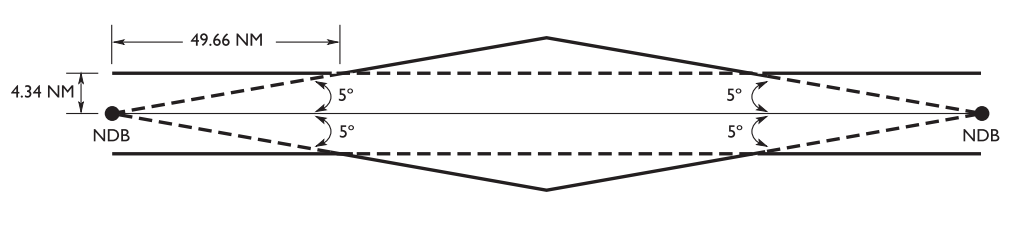
LF/MF Airway — NDB to NDB (4.34 NM each side, 5° splay)
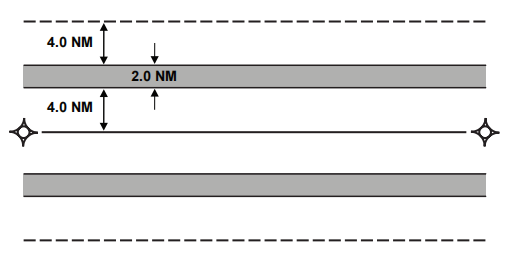
T-Route (Fixed RNAV) — 4 NM primary + 2 NM secondary each side
| Class | Type | IFR |
|---|---|---|
| A | High-level (≥18 000 ft ASL) | ATC clearance req'd |
| B | TCA (Terminal Control Area) | ATC clearance req'd |
| C | Controlled with ATC service | ATC clearance req'd |
| D | Control zone | ATC clearance req'd |
| E | Controlled, no ATC svc | ATC clearance req'd |
| F | Special use (advisory/restricted) | Check NOTAM/AIP |
| G | Uncontrolled | No clearance (file itinerary) |
- Attitude indicator
- Vertical speed indicator (VSI)
- Outside air temperature (OAT) gauge
- Pitot heat (anti-ice for each ASI)
- Vacuum / power failure warning device
- Alternate static source (for altimeter, ASI, VSI)
- Two-way radio (appropriate frequency)
- Radio nav — enough redundancy to complete approach in IMC
- Day VFR instruments: altimeter, ASI, compass, clock, VSI, turn coordinator
- All day IFR equipment above
- All night VFR equipment (CAR 605.16(1)(i) to (k))
- Position lights, anti-collision lights
- Landing light (for hire)
- ADF (functioning)
- OAT gauge
- Required in Class A, B, and C airspace
- Required within 12 NM of Class B aerodrome boundary
- Mode C (altitude encoding) required in Class A, B, C
- Emergency: squawk 7700
- Communication failure: squawk 7600
- Unlawful interference: squawk 7500
Within the preceding 6 months, the pilot must have completed all of:
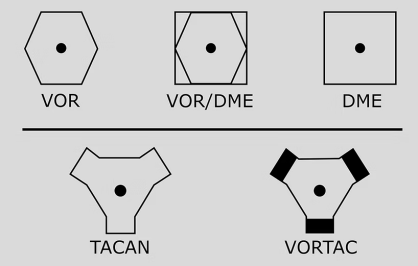
VOR, VOR/DME, DME, TACAN, VORTAC symbols
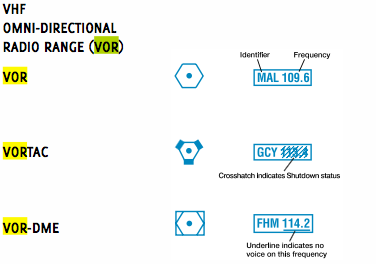
VOR chart symbology — underline = no voice
- Mountain Effect — signal diffraction over terrain
- Twilight / Night Effect — sky wave interference at sunrise/sunset
- Shoreline Effect — refraction crossing coast at <30°
- Bank Error — dip in needle when turning (fixed card only)
- Thunderstorm Effect — needle attracted to storm; use higher frequency to reduce
| Category | DH | RVR / Visibility |
|---|---|---|
| CAT I | 200 ft | RVR 2 600 ft (½ SM) |
| CAT II | 100 ft | RVR 1 200 ft |
| CAT III | < 100 ft / 0 | RVR < 1 200 ft / 0 |
- Track a constant DME distance from a VOR/TACAN
- Turn 10° toward station when DME increases; away when decreases
- Use CDI for final course intercept from the arc
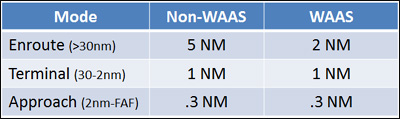
CDI sensitivity — Non-WAAS vs WAAS
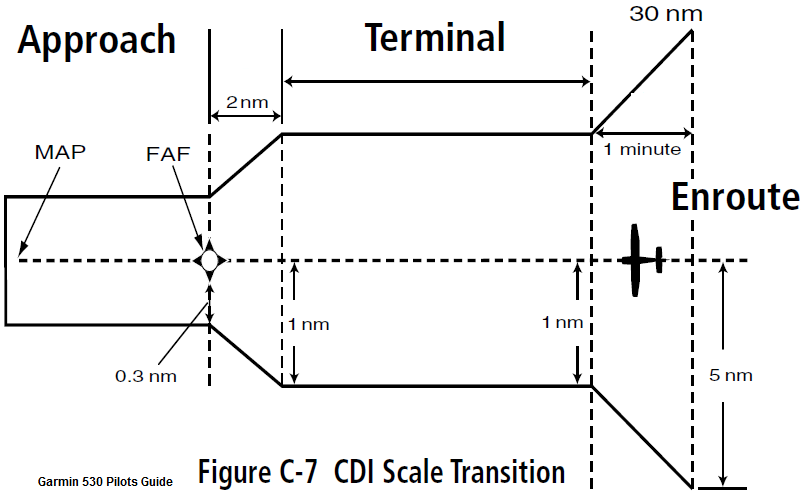
CDI scale transitions: En route (±5 NM) → Terminal (±1 NM) → Approach (±0.3 NM)
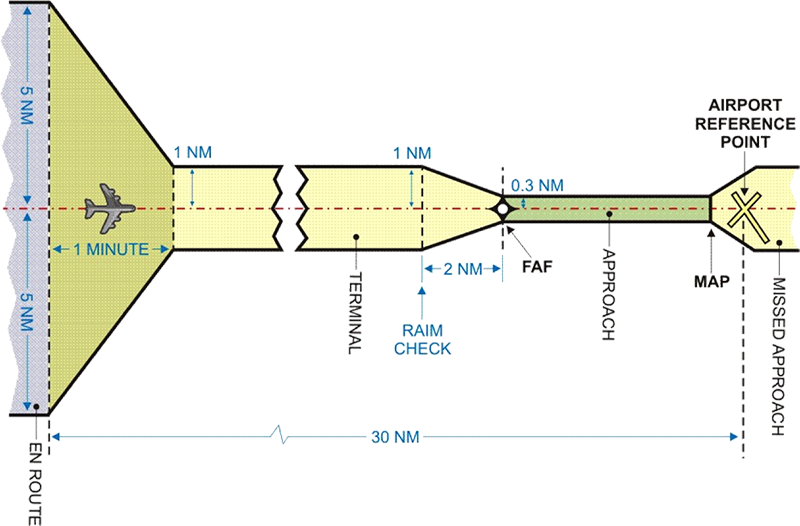
GPS RAIM check zones — terminal starts 30 NM from dest, RAIM check at 2 NM before FAF
- Standalone RNAV (GNSS) — charted as "RNAV (GNSS) RWY XX"; T/Y-bar eliminates procedure turn
- Overlay approaches — traditional VOR/NDB approved for GPS; charted as "NDB RWY 29 (GNSS)*"
- Overlay: underlying nav aid need NOT be monitored
- Overlay: can fly even if underlying nav aid is NOTAMd out of service
- LNAV/VNAV and LPV = approaches with vertical guidance (APV)
- IFR-certified GPS unit required
- RAIM must be predicted available at alternate ETA
- One traditional nav aid approach must be available at alternate
- Destination must have a traditional nav aid approach for flight planning
- Check RAIM prediction at least once before mid-point of flight
- IFR GPS can track airways & air routes as primary nav
- Must still carry traditional nav aids to meet CARS
- In uncontrolled (Class G): must have ≥ 1 functioning ADF
- GPS may substitute for DME, VOR, VOR/DME, ADF — fixes must be in current database, no RAIM warning
- 2 GPS approaches (dest + alternate) must be ≥ 100 NM apart
| Term | Use for alternate | Applicable from/to |
|---|---|---|
| BECMG improving | Must meet alternate minima | End of BECMG period |
| BECMG deteriorating | Must meet alternate minima | Start of BECMG period |
| TEMPO | Must meet alternate minima | Any time during TEMPO |
| PROB | Must meet landing minima only | Any time during PROB |
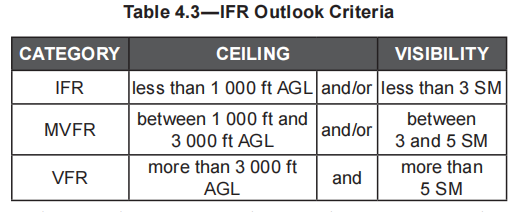
Table 4.3 — IFR Outlook Criteria (ceiling & visibility categories)
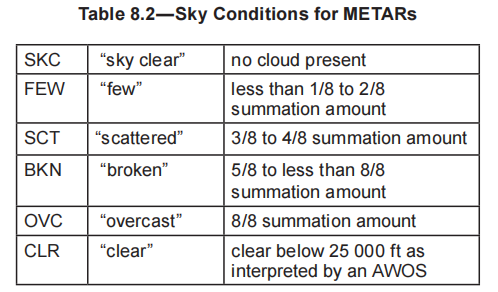
Table 8.2 — METAR sky condition codes
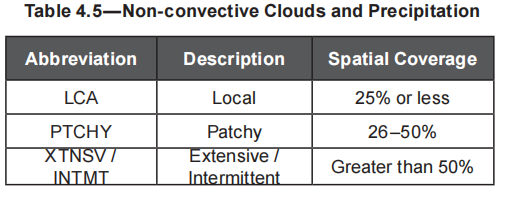
Table 4.5 — Non-convective cloud & precipitation coverage
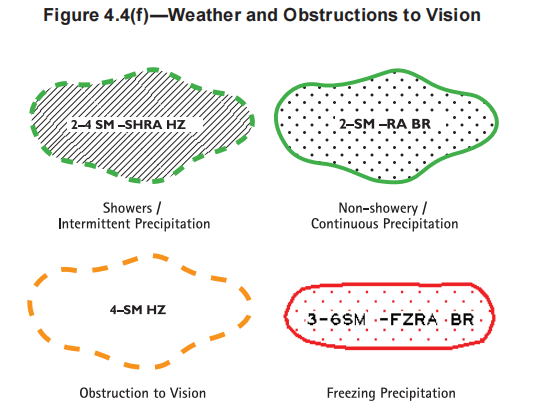
Figure 4.4(f) — GFA weather & obstruction symbols
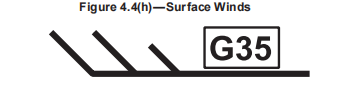
Figure 4.4(h) — Surface wind with gust (G35)
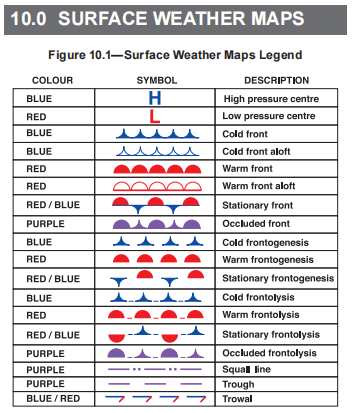
Figure 10.1 — Surface weather map symbols & fronts
- TAF available — ceiling 500 ft above lowest HAT/HAA, vis ≥ 3 SM
- Aerodrome Advisory forecast — ceiling 500 ft above lowest HAT/HAA, vis ≥ 3 SM
- GFA only — no cloud <1 000 ft above lowest HAT/HAA, no CB, vis ≥ 3 SM
Example: AAE 620 ft → ceiling value = 600 ft; HAA 621 ft → ceiling value = 700 ft.
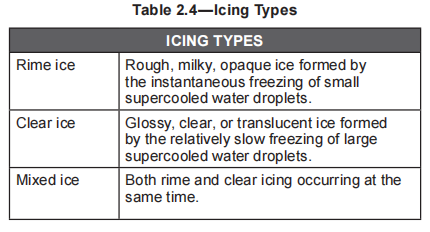
Table 2.4 — Icing types (Rime, Clear, Mixed)
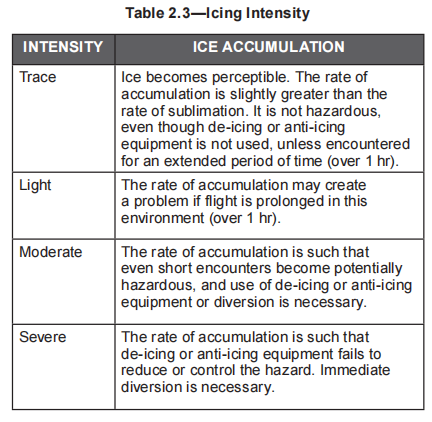
Table 2.3 — Icing intensity & required action
- Forms in clear air when parked overnight below 0°C
- Forms descending/climbing through temperature inversion (cold-soaked fuel in wings)
- Can form on wing surfaces even when ambient temp is above freezing
Destination must have sky condition SCT or CLR and visibility ≥ 5 SM with no forecast of precipitation, fog, thunderstorms, or blowing snow:
Aircraft fuel supply has reached a state where the flight is committed to land at a specific aerodrome and no additional delay can be accepted. Declare MINIMUM FUEL — not an emergency, but ATC must be informed.
Declare MAYDAY when fuel remaining is less than required to safely complete the flight. This is an emergency — ATC provides priority handling.
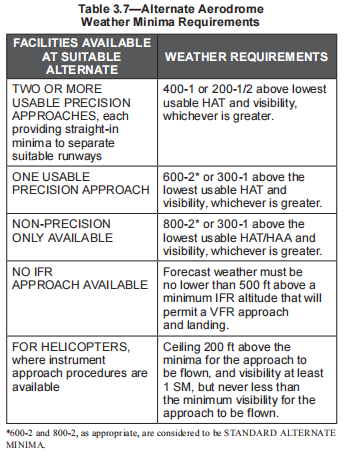
Table 3.7 — Alternate aerodrome weather minima requirements by facility type
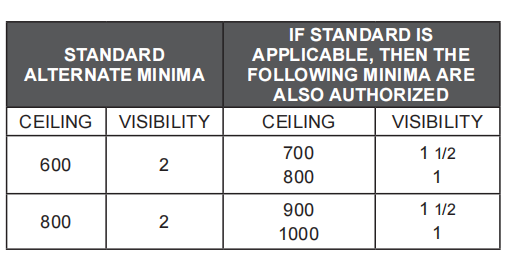
Standard alternate minima and authorized reduced minima
- When the destination does not have a suitable forecast for the approach
- When the TAF or GFA forecast shows conditions at or below alternate minima
- When no instrument approach procedure exists at destination
- "NOT ASSESSED" means departure has not been evaluated for obstacle clearance
- PIC is responsible for determining minimum climb gradients
- If "NOT ASSESSED" on plate → use ½ SM or RVR 2 600 ft
- "*" on plate = obstacles in takeoff path → use climb gradient chart
- Upslope runway → illusion you are high → approach too low
- Downslope runway → illusion you are low → approach too high
- Narrow runway → feels farther away → approach too low
- Wide runway → feels closer → approach too high
- Rain on windshield → runway appears closer → approach too low
- Featureless terrain (water, snow at night) → approaches too low
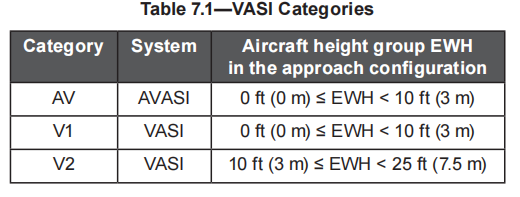
Table 7.1 — VASI categories by aircraft eye-wheel height (EWH)
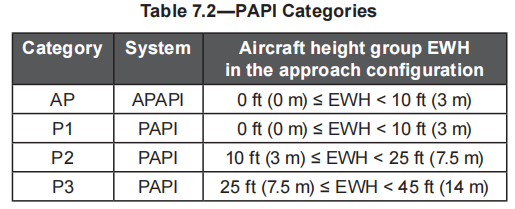
Table 7.2 — PAPI categories by aircraft eye-wheel height (EWH)
- Not required if: "NoPT" on chart, radar vectors, timed approach, or holding in lieu
- Must be completed on published side of course
- Maximum distance from fix: as published (typically 10 NM)
- T/Y-bar (GNSS approaches) eliminates procedure turn
Notify ATC as soon as practicable of changes to:
- Cruising altitude or flight level
- Route of flight
- Destination aerodrome
- TAS change ≥ 5% of filed TAS (controlled airspace)
- Mach change ≥ 0.01 Mach (controlled airspace)
- Busy airport — clearance from clearance delivery frequency
- No clearance delivery — clearance from ground control
- No tower, FSS present — FSS puts clearance on request with ACC
- Uncontrolled airport — telephone ACC → receive clearance void time
- Cleared unless NOT airborne by clearance void time
- Departing Class G without void time: advise ATC before entering controlled airspace
- If >1 hr late departing from Class G: advise ATC or SAR activates
- Set transponder to 7600 immediately
- Attempt contact on any available frequency
- Monitor 121.5 MHz (emergency frequency)
- Continue in VMC
- Land as soon as practicable
- Notify ATC by any means
- Continue on the last ATC clearance or expected clearance
- Follow the filed route to the destination
- Maintain the last assigned altitude, or MEA if higher
- At destination: begin approach at the ETA from the flight plan or last ATC ETA
- If holding: hold at the published EFC time
| Category | Speed (kt) | Typical A/C |
|---|---|---|
| A | < 91 kt | Small singles, SEP |
| B | 91 – 120 kt | Light twins, turboprops |
| C | 121 – 140 kt | Jets, medium turboprops |
| D | 141 – 165 kt | Heavy jets |
| E | ≥ 166 kt | High-performance military |
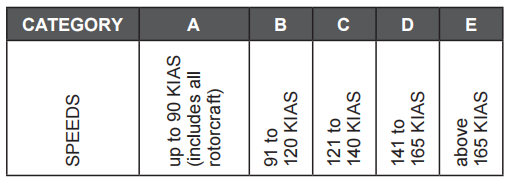
Aircraft approach category speeds (KIAS)
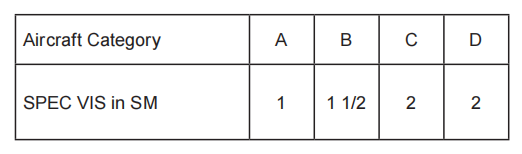
Specified visibility (SPEC VIS) by aircraft category
| Category | Max Circling Speed |
|---|---|
| A | 90 kt |
| B | 120 kt |
| C | 140 kt |
| D | 165 kt |
| E | No limit published |
Against the arrow = odd altitudes.